How the Coliving Industry is Building a $16 Billion Comeback Story
Ajay Kumar

In 2020, coliving came dangerously close to collapse.
Tenants moved out overnight, operators shut down, and fixed leases kept draining cash.
Most thought it was game over.
But five years later, the coliving sector is back. Quietly, steadily, and with better fundamentals than before.
Just look at the numbers:
- The global coliving industry is projected to grow at a 13.5% compound annual growth rate (CAGR) from 2025 to 2030.
- By 2030, the market is expected to reach $16.05 billion in value.
A bounce-back like that doesn’t get enough credit.
It’s one of the boldest and most underrated comeback stories in real estate.
--------------------------------------------------------------------------------------------------------------------
Quick Overview
- Coliving nearly collapsed in 2020, but is now on track to reach $16.05 billion by 2030
- Operators shifted to revenue share and hybrid 1–6 month rentals
- The new model offers better margins, less risk, and more flexibility for all stakeholders.
--------------------------------------------------------------------------------------------------------------------
The Big Pivot Post-COVID
Before 2020, most coliving businesses relied on fixed leases and long stays. That model broke when tenants left, but the costs didn’t.
The smart operators changed course. Here’s what they did differently:
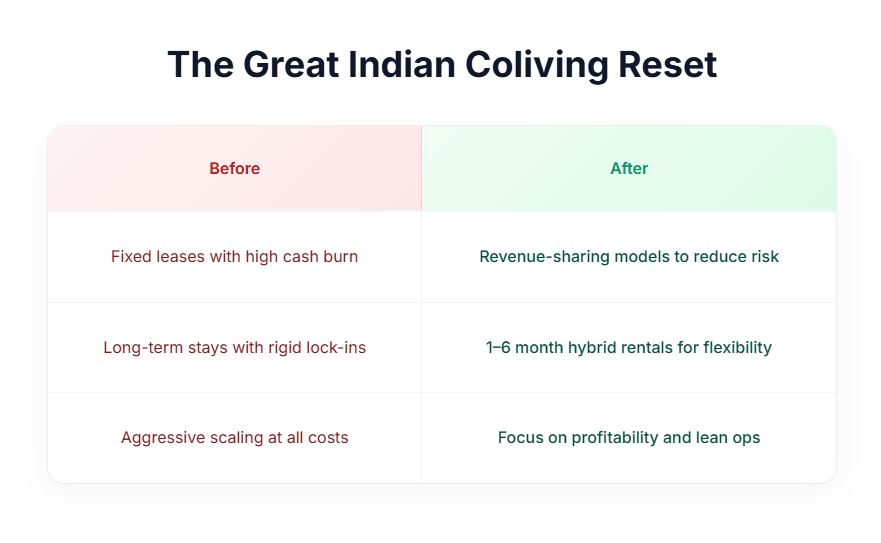
The reset wasn’t optional; it was survival.
But it pushed operators to rebuild smarter, and that’s what turned a crisis into momentum.
Why the New Coliving Model Works
What makes this version of coliving different is simple: everyone benefits, and no one carries all the risk.
- Tenants get flexible, well-managed spaces without long lock-ins.
- Operators run leaner teams with lower overhead and steadier cash flow.
- Landlords earn more than traditional rentals, without the hassle.
- Tech handles onboarding, rent, and service, making scale possible without bloat.
When each piece works better, the whole system gets stronger.
Adaptability > Perfection
Many models crack when the market turns, but Indian coliving spaces didn’t.
That willingness to evolve is why the coliving still works and why I admire it.
Real estate doesn’t reward perfection. It rewards speed, clarity, and the guts to let go of what no longer works.
The Next Evolution
As coliving scales, a new challenge has emerged: operational complexity.
Many operators who survived 2020 are now looking to grow, but their tools haven’t kept up. Once again, the fastest to adapt are pulling ahead.
The most successful coliving operators are now embracing a digital-first approach.
They use integrated systems built to handle hybrid stays, revenue-sharing models, and multi-city operations.
The question isn’t if the coliving industry will grow.
It’s who will be ready when it does.
Explore More



See what happens
when AI runs execution.
If your teams are stretched by noise, the problem is not intent. It is execution at scale. Let's fix it today.